
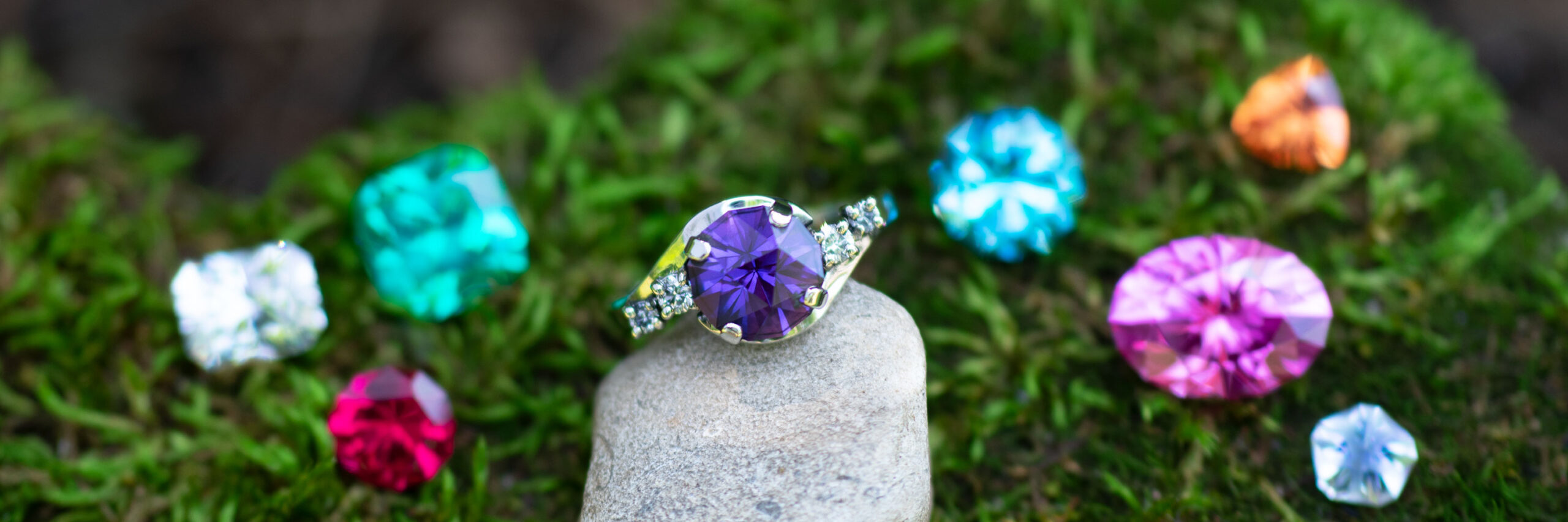
When you look at colored gemstones in a jewelry store, you are usually looking at “commercial cuts.” For 99% of the colored gemstone market, this is the standard. It more or less sparkles, it’s colorful, and it fits in a ring.
But if you have ever seen a gemstone that seemed to glow from the inside, or one that flashed colors you didn’t expect it to, you were probably looking at a precision cut.
As a gem cutter and jeweler, a common question that I get asked is: “What makes a custom-cut stone look different from the one at the mall?”
The answer lies in physics, geometry, and a major difference in philosophy: are you cutting for weight (profit), or are you cutting for beauty (performance)?
Here is what you are actually paying for when you buy a precision-cut gemstone.
- Understanding Commercial Cuts
To understand cut quality, you first have to understand the industry standard. Most commercial gemstones (“native cuts” or “commercial cuts”) are cut overseas in factories where speed and weight retention are the only metrics that matter.
A commercial cutter is often paid by the carat weight of the finished stone. If they remove too much material in order to make the angles close to perfect, they lose money. Therefore, they cut the stone to be as heavy as possible, often ignoring the laws of physics that govern how light travels.
This leads to two big problems in stone cutting: windowing and extinction.
The “Window” (The See-Through Stone)
Have you ever looked at a gemstone and seen right through the center, like looking through a pane of glass? You can see the skin of your finger or the metal of the setting behind it. This is called a window.
A window happens when the angles on the bottom of the stone (the pavilion) are too shallow. Instead of bouncing light back to your eye, the light “leaks” out the back. A windowed stone looks lifeless in the center, usually with just a rim of flashy light and color around the edge.
Extinction (The Black Hole)
On the flip side, if the angles are too steep, light that enters the gem can be bounced around and then sent out in the wrong direction; not in the direction of your eye. A pavilion that is too steep can also lead to a dimming effect where a reduced amount of light enters into the gem from the bottom.
The result is known as “extinction”, which shows as dark, dead spots. Some extinction is always present in gemstones because of the complex way that light interacts with facet angles, but pavilions that are too deep show an unnecessary amount. Gemstone cutters who create unique cuts often work around the principal of extinction, designing dark and light areas that compliment one other.

Left: A commercial cut amethyst with a large “window” in the center (text reads through it). Right: A precision-cut beryl showing full light return.
- The Science of Brilliance & Sparkle: Critical Angles
Every gem material, whether it’s sapphire, tourmaline, or garnet, has a specific refractive index (RI). This is a measure of how much light bends when it moves from the air into a gemstone material (or any other material). Based on the refractive index, there is a specific range of pavilion angles required to make the light that enters the stone reflect internally, and then bounce back out toward the viewer’s eye.
- If I cut the main pavilion facets of a sapphire at 39 degrees, the light bounces back to your eye when viewing it from above.
- If I cut the main pavilion facets of that same sapphire at 34 degrees, the light falls out the bottom.
In precision cutting, gemstone cutters calculate the angles needed for a specific material to maximize light return. They use basic laws of physics to ensure that when light enters the stone, it has no choice but to be sent back out the top, toward the viewer’s eye.
- The Process: How a Precision Gem is Born
Commercial stones are often cut using what is known as a “jambpeg” machine. The cutter slots a stick that holds the gemstone into one of a series of holes in order to achieve an angle to cut the stone at. On some of these machines, these holes do not allow for fine angle adjustment, which makes cutting certain angles difficult or impossible. Using a jambpeg machine can be a very fast way to cut a gemstone. With the right machine and an experienced cutter, they can also be accurate.
Many precision cutters, especially in North America and some European countries, prefer to use a modern mast-style machine. This type of machine can be very accurate, with professional models made to tight tolerances, incorporating digital displays that measure to 1/100th of a degree. Their high degree of angle accuracy and repeatability allows for a more fine-tuned dialing in of facet angles, which can translate to more precise cutting.

An Antique Jambpeg Faceting Machine
Modern jambpeg machines are more advanced than this antique, but the principle of operation remains the same: The gemstone is attached to a long wooden or metal stick, and then inserted into a hole on the jambpeg head (the large vertical wood piece on the right)

Digital Mast-Style Faceting Machine
The Ultra Tec faceting machine that I am currently using. There are a few brands of high quality American-made faceting machines, Ultra Tec being the most popular among precision cutters.
The “Meetpoint” Technique
Most precision cutters today use what is known as the “meetpoint” technique. As the name suggests, this is a way of placing new facets based on where they meet the corners of previously placed facets. This is a very accurate way to cut a stone, with facet corners often meeting at a microscopic point.
Below video: Cutting a gemstone on a modern mast-style machine.
- The Economics: Why Custom Cuts Cost More
There are a few reasons for this. The most obvious is that a brilliant gemstone (brilliance is the gemological term for light return toward the viewer’s eye) is usually more appealing. Brilliance is the direct result of well calibrated facet angles, meaning that brilliance is also a good indicator of cut quality. Crisp meetpoints, highly polished facets, and properly calibrated angles will produce a gem that costs more simply because it’s more impressive to look at, as well as the fact that it is rarer than commercial cuts.
But there is another major factor involved in pricing. If you look at a 2 carat commercial amethyst and a 2 carat precision-cut amethyst, the commercial stone will likely have been cut from a smaller piece of rough material.
Imagine a commercial cutter and a precision cutter both start with a 10 carat piece of rough.
- The Commercial Cutter: Wants to keep as much weight as possible. They bulge the belly of the stone and cut shallow angles. They finish with a 5 carat stone that has a window and not-so-great sparkle.
- The Precision Cutter: Wants to maximum beauty. They grind away everything that doesn’t contribute to light return. They might cut that same piece of rough into a 2.5 carat stone.
Compared to the commercial cutter, the precision cutter has sacrificed 2.5 carats of potential product to give you a stone that performs optically.
In short, you are paying for a better optically performing gem, as well as the time, the skill, and the material that was sacrificed to bring out a gemstone’s true potential.
- Side-by-Side Comparison
The video below is the same comparison of the commercial cut amethyst and the beryl shown in the image above. The beryl was chosen because it has a refractive index that is close to quartz, which amethyst is a variety of. The beryl is a lot smaller, but hopefully you get the picture!
Below video: Notice how the commercial amethyst only appears “alive” around its rim; the center looks lifeless. The beryl remains lively, showing scintillation (changing flashes of light) throughout the full width of the stone.
- From Stone to Heirloom: The Jewelry Connection
When we design custom jewelry around a gemstone, we have to consider the “seat.” Because precision cuts often have slightly deeper bellies (to facilitate the correct angles), standard off the shelf settings often do not fit them.
For our jewelry, I regularly create settings for a specific gem that I have cut, but a local jeweler should be able to create a setting that will match any stone.
Below video: A precision cut rainbow moonstone ring made by us. The setting had to be custom made to accept the moonstone’s deeper pavilion.
Frequently Asked Questions
Q: Are the lab-created stones that you sell also precision cut? A: Yes, whether it is a natural tourmaline or a lab-created sapphire, the physics of light remain the same. I apply the same “meetpoint” technique to lab-created stones as I do to natural gems.
Q: Can I request a custom cut in a particular material, such as sapphire, garnet, etc? A: Yes, but whether or not I will be able to fulfil the request depends on the material that I have available at any given time. It is much more likely that I will be able to cut a lab-created stone in the desired shape/cut because we usually have lab-created rough in stock in various colors.
Q: Can you cut a rough stone that I send you? A: We are not currently cutting rough gems from customer-provided material at this time.
Q: Can you recut a commercial stone that I already own? A: We do not currently offer a re-cutting service.