
Understanding Light Return: Why Some Stones Glow and Others Don’t
The Mystery of the “Dead” Stone
In the gemstone market, there’s a lot of talk about color and clarity, but the factor that often determines if a stone looks “alive” or “dead” is something called light return.
Simply put, when light enters the top of your gemstone, does it come back to your eye or does it fall out the bottom?
Light Return
Light return is a simple but important concept in gemology:
- Light enters the top (the crown).
- It hits a facet on the bottom (the pavilion).
- It bounces across to another facet.
- It shoots back up to your eye.
Gemstones that exhibit good light return can appear like they are glowing from the inside, but a gemstone that is cut poorly will allow light to leak out the bottom. This is one of the major differences between precision cut vs. commercial cut gemstones.
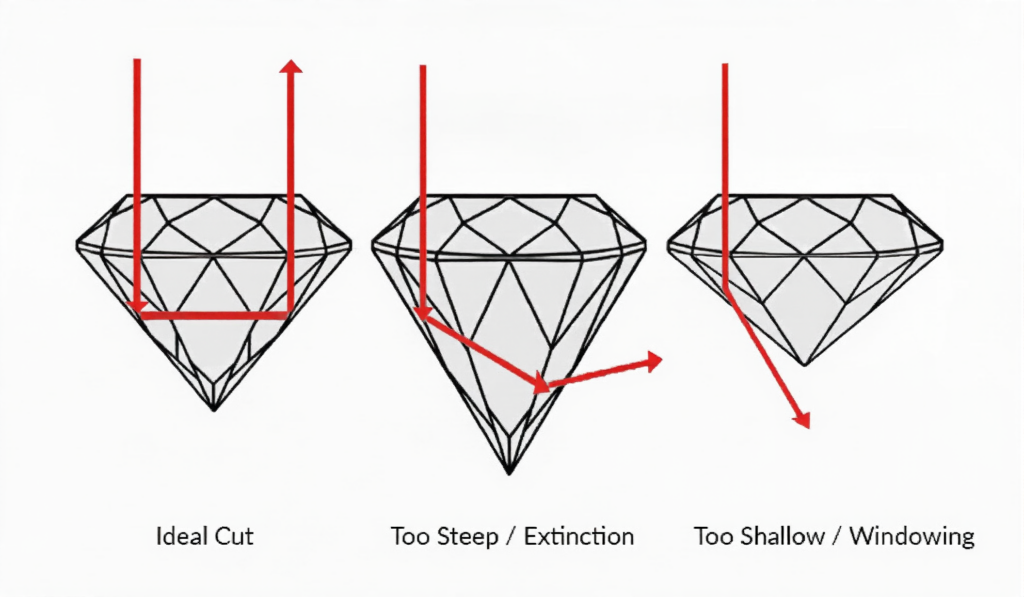
The Science:
The variables involved in light travelling through a gemstone are complex. For this brief article, we will stick to the basics.
How do we make light travelling into a gemstone bounce back towards the viewer’s eye instead of passing through it? It comes down to the science of optics; specifically, a property known as “critical angle”.
Oxford Languages defines critical angle as: the angle of incidence beyond which rays of light passing through a denser medium to the surface of a less dense medium are no longer refracted but totally reflected.
So, to break that down a little: There is an interesting physical property of light that makes it reflect off of a surface when that surface is the boundary between a denser medium (our gemstone) and a less dense medium (the air). When light travelling through a gemstone hits the edge of its boundary – say, a facet on the bottom of the stone – there are two options for it. It can either be internally reflected, and remain within the gemstone, or it can be refracted, leaving the gemstone and passing into the air.
Whether or not our hypothetical light ray stays within the gem depends on the gem’s critical angle, which differs from one mineral species to the next. For example, the critical angle of sapphire is 34.6 degrees. This means that a light ray travelling within a sapphire will be internally reflected, staying inside of the gem, provided it hits a facet at an angle above 34.6 degrees. If it hits a facet at an angle below 34.6 degrees, it will refract through the facet, leaving the stone.

A critical angle “cone” within a gemstone. Sapphire’s 34.6° critical angle is used in this example. As long as light hits a facet above 34.6° (i.e., outside of the cone) as measured on either side 90° perpendicular the facet plane, it will stay within the gemstone.
Color:
There is another important point to mention here regarding light return. If a gemstone has color, that means that light is being absorbed; the greater the color saturation, the higher the absorption. Highly saturated gemstones will have significantly less light return than lightly saturated stones, simply because more light is being absorbed by the gemstone. This isn’t always a negative. Deep shades of blue sapphire are highly sought after, even though less light is able to be bounced back to your eye.
Conclusion:
If you are looking for a gemstone with high light return, you may want search for precision cut stones. When buying a gemstone online, make sure that a video is provided, otherwise you will not be able to get an idea of how light interacts with the stone.
Finding a gemstone cutter with a basic understanding of the science of optics, specifically the importance of critical angle, will help to ensure that the gemstone you purchase is lively, and not a dud.